
A Christmas Story
Christmas often makes us pause and reflect. Not only on the birth of Christ or the beginning of everything. But also, for example, on the beginning of taxation. We also analyzed a scene from a film.
About birth
Have you ever wondered when and how taxes began? What problems were people trying to solve at that time? It is often useful to go back to the beginning to understand from history what is meant and what would be more appropriate.
Individual sacrifice for the common good
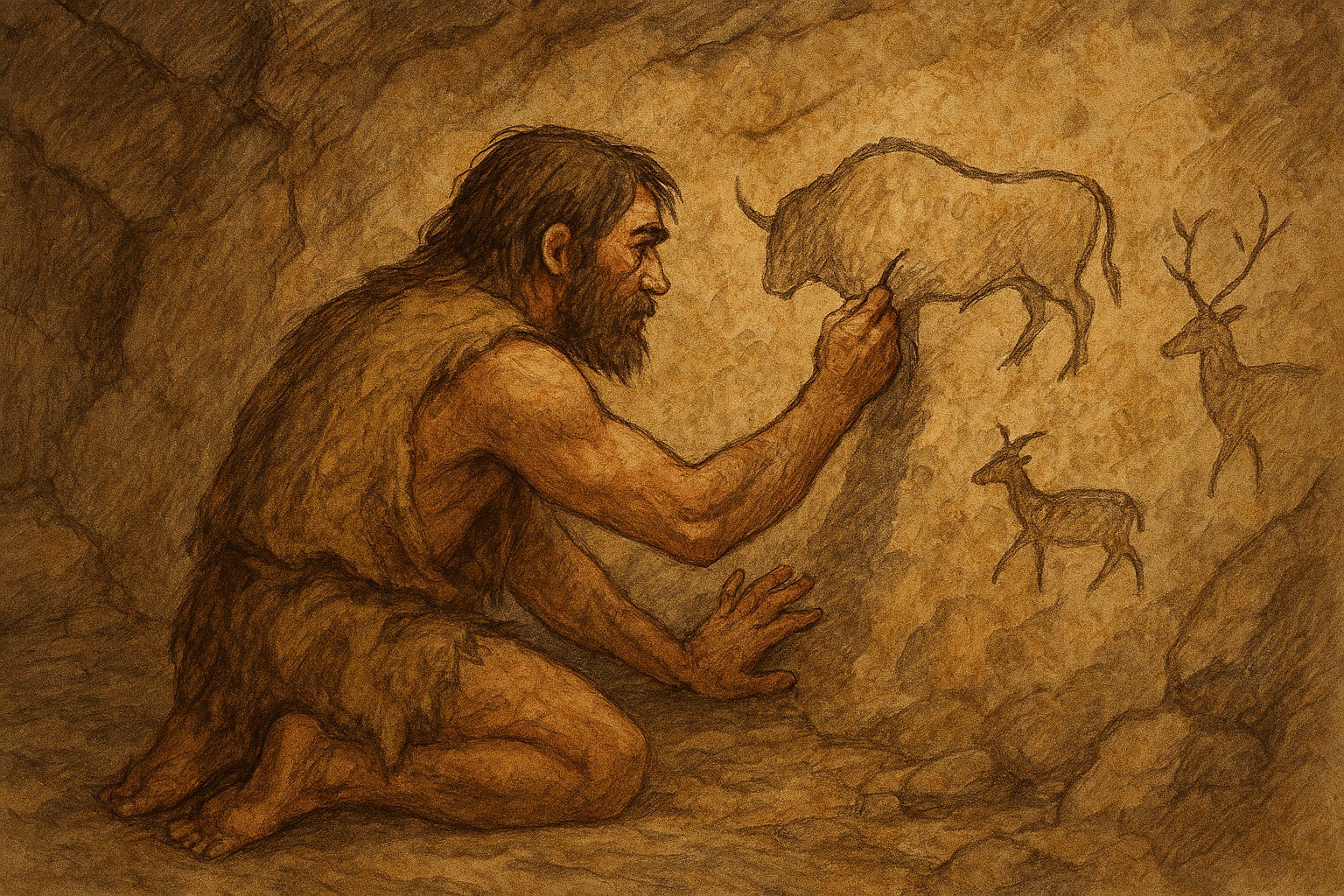
These issues are well described by tax historian F. Grapperhaus in his book Taxes through the Ages. He writes that from the very beginning there has been mutual misunderstanding and conflict between taxpayers and those who collect and spend taxes. However, it all began long before Christ, when 15-20 thousand years ago someone began to draw cave paintings. The community had decided that the artist should do this. Perhaps to ask the gods for good luck in hunting. Meanwhile, other members of the community provided him with food and raw materials. Thus, even then, there was an understanding that individual sacrifices were necessary for the common good. Much later, 10-12 thousand years ago, farmers began to build protective fences for similar reasons. In turn, community leaders collected part of the harvest and distributed it among community leaders and the neediest.
How to distribute fish fairly?
I would like to tell another story on this topic. There was an excellent discussion about the nature of taxes in TS podcast 70 with Oxford University professor R. de la Feria, especially when we discussed the wonderful film Triangle of Sadness. In it, a yacht was wrecked in a storm and its passengers ended up on a seemingly uninhabited island. At that moment, everyone’s roles suddenly changed. Both the wealthy passengers and their crew wanted to eat. But how to divide the fish they caught, if only the lady from the crew caught them? Why should she share with anyone at all? Okay, she agreed to share, but how? The crew lady herself decided – in half. One half for herself, one half for the others sitting around the campfire in the evening, who were also hungry.
“No!” objected the head of the crew (on the yacht). “Why should you get so much food?”
“Why? I caught the fish, I built the fire, and I cooked the fish. I did all the work. And everyone got something to eat.”
“We all worked.”
“What then?”
“We brought the firewood. We all have to work together! The others don’t know how to do it.”
“Exactly! Maybe that’s why you shouldn’t all be so lazy and dependent on me.”
“On the yacht, you were the toilet manager.”
“On the yacht, yes, but where is the yacht? Here, I’m the captain.” And she began to distribute pieces of fish to everyone who agreed that she was the captain.
Incidentally, I also liked the metaphor of the triangle of sadness, as the space between the eyebrows that can be smoothed out with Botox. The filmmakers thus poke fun at a society in which people try to sweep the misfortunes of society or deep questions of coexistence under the rug with absurd glamour. The film is about every person’s fears, instincts, and choices, and could appeal to representatives of both sides of the inequality divide.
How could this scene be interpreted?
Why share the fish at all?
At the very least, for safety, so that the others don’t lynch the only eater, or out of compassion for the others (who have suddenly become poor). In conversation, Professor TS referred to research in her latest book, Taxation and Inequalities, which is now available free of charge (!). The professor mentioned that inequality (not sharing the fish) is bad for human health, crime rates, happiness, and brings a host of other negatives. However, in the film, the rich people (who have suddenly become poorer than toilet managers) are upset that they can no longer get as much fish as they want (but I deserve it!).
Rita de la Feria says in her podcast, among other things, that it is not so much income inequality that has grown, but wealth inequality. And with social networks, this wealth inequality is becoming increasingly visible. Just like in the movie, people are becoming increasingly angry about this in real life. The professor argues that in countries where inequality is more pronounced, populists from the far right are increasingly winning elections.
How to share?
Ten people sitting around a campfire watch as they are given “only half of the fish,” but the toilet manager, who has done almost everything on her own, thinks that even that is a lot—giving away half. Why not divide everything equally among everyone sitting around the campfire?
The professor, talking about this scene, says that in times of high inequality, tax policy does not usually go against the dissatisfied majority. Usually, the opposite is true. Scientists are surprised by this phenomenon—why doesn’t the majority demand more for themselves in such cases? One theory is that in situations of high inequality, people focus more on their own needs and those of their loved ones, rather than on social consolidation. Thus, in such circumstances, people become more selfish.
The latest data on GINI (inequality coefficient)
The Eurostat table below shows that the proportion of people living on the poverty line has decreased since 2019 and we are approaching the EU average. With the government introducing a monthly threshold of EUR 1,000 for pensioners that is not subject to personal income tax, this proportion could change even more. However, the next Eurostat graph shows that the inequality coefficient itself is still relatively high in our country.
How else can inequality be reduced?
The professor mentioned that inheritance tax (which we do not have) is one of the most effective mechanisms for combating wealth inequality, as attempts to introduce an effective wealth tax have so far been unsuccessful anywhere in the world. Nevertheless, research in the professor’s book published this year indicates that there is also strong resistance to inheritance taxes in almost all countries. What’s more, the number of countries that apply such a tax is decreasing, as is the number of people to whom this tax applies. The professor also mentioned that the simplicity of the tax system also increases the desire to leave the gray sector.
However, the most interesting conclusion of the study seemed to me to be that in countries with the lowest GINI coefficient (Austria, Scandinavia), inequality is eliminated through welfare systems (benefits, etc.) rather than through the tax system.
Other thought-provoking questions
Why do bad people exist?
My 7-year-old son occasionally comes out with some gems in our conversations. Yesterday, for example, he asked, why do bad people exist in the world? Everything would be so good if there were only good people. A few weeks earlier, he asked why poison exists in the world. Nothing good can be done with it.
How does an innocent child grow up to be a criminal?
I am interested in the moment or moments when a little angel, which is what we all are in childhood, gradually becomes a criminal, such as the leader of a neighboring country. That is why I bought the book A Mind to Crime, in which psychologists put forward the theory that some people are born with a greater tendency to commit crimes. Once I have studied the book, I will write another blog post about it.
Perhaps the model for the tax system is already in the Old Testament?
Until then, we can only rely on the Bible, which says that man is weak and unable to refrain from original sin. And speaking of the Bible, isn’t the tithe a model that has been written down for thousands of years as an example of what a tax system should be? The history of taxation is full of interesting stories. I hope to share at least some of them in these blogs.
May this moment of reflection and respite be full of revelations and inspiration for you, or at least a moment to watch a good movie!


