
How did taxes come about?
F.H.M. Grapperhaus has expressed some interesting theories on this subject in his book Taxes Through the Ages. It is suitable reading material for a flight to Egypt.
In this blog:
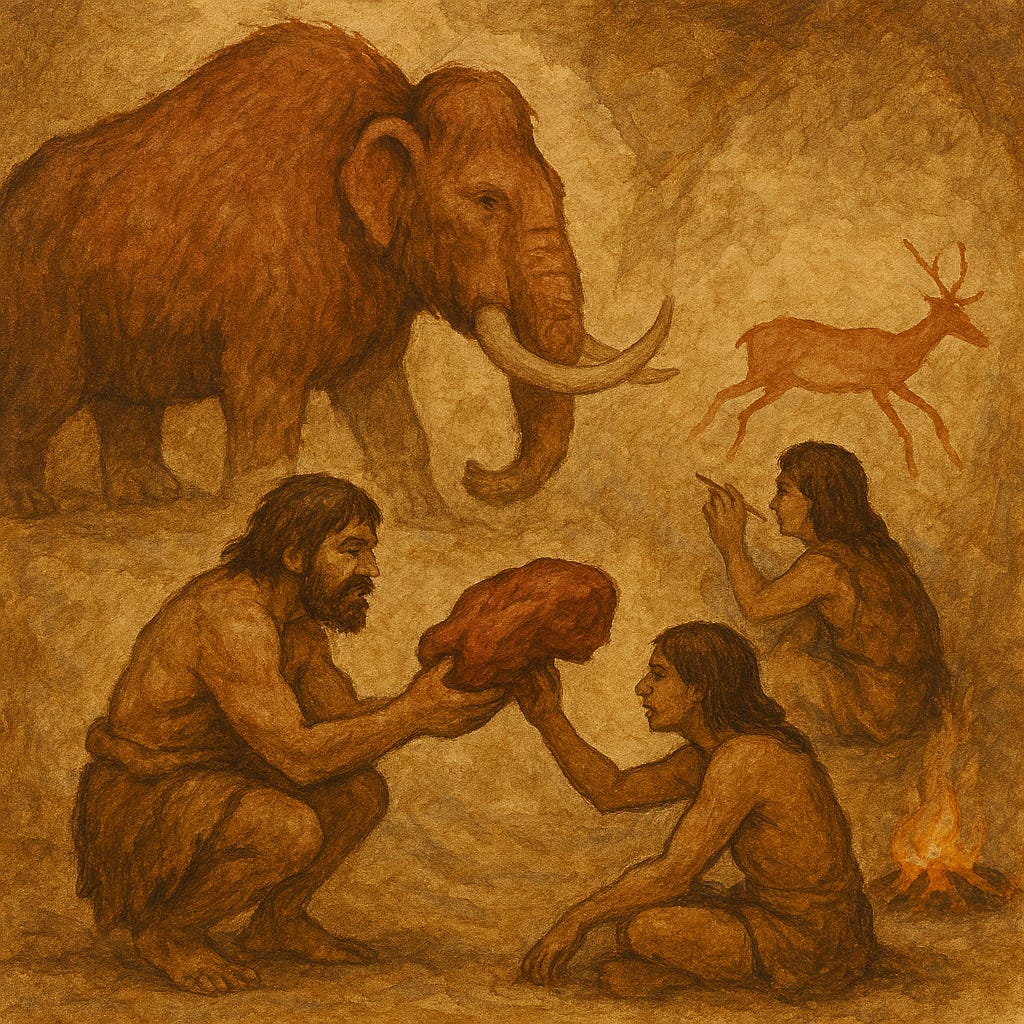
• 🦣 Cave people share mammoth meat with hearth keepers and cave painters.
• 🛡️ Villagers behind fortifications negotiate with raiders offering “protection.”
• 🌊 Ancient Egyptians measure the water level of the Nile to calculate possible taxes.
• 📜 Strict tax collectors collect duties.
• 🏗️ Pyramid construction with forced labor, symbolizing the blurred line between taxes and work.
A portion of the mammoth goes to those who perform important work for the community
One of these is related to cave people. Those living in caves soon realized that not everyone would go hunting. Some had to tend the hearth, while others had to draw pictures on the cave walls for future generations about the life of cave dwellers. Understandably, the hunters then shared their catch with both the hearth tenders and the artists. In other words, the hunters shared with others who did work necessary for the community but did not bring home mammoths.
Rulers = robbers who are paid for their “roof”
Another story is related to a community (village) in later times, which fortified itself behind fence walls. Robbers would visit the villagers from time to time. It was in their interest not to rob the villagers completely, so that they would have the means to produce new goods for the next visit of these robbers. Secondly, it was also in the robbers’ interests to protect the village from other robbers. After a while, the robbers realized that they could do the same thing by living in the village itself. So they imposed rules on the villagers, and the share of the loot was essentially equivalent to modern taxes (a portion was taken away, but the villagers received protection from others in return).
Presumption
On the flight to Egypt, it was interesting to read that a couple of thousand years before Christ, one of the first countries to apply taxes was formed there. But how? It was too difficult and labor-intensive to keep track of every farmer’s fields. This led to the introduction of presumptive taxation—based on approximate calculations to which various coefficients were applied. For example, the water level in the Nile was measured in different areas to determine the fertility of the land in a given season and adjust land tax calculations accordingly. Incidentally, the presumptive tax system still exists in a number of countries (as discussed in the TS blog). With such a fixed land tax payment, farmers were interested in growing the best possible harvest, as this resulted in a larger tax-free surplus.
Capital
In Egypt, taxes were levied not only on real estate, but also on movable property (livestock), or capital. Over time, this concept began to be applied more broadly to the stocks of merchants and craftsmen. Profit as an object did not exist at that time – it was invented only a hundred years ago.
Tax collectors
The book states that Egyptian tax collectors were famous for their harshness until the 19th century. In this respect, too, a 3,000-year-old truth applies to the present day: if you drive a farmer into a corner, he will run away, but if you treat him kindly, he will still be there next year.
Labor
As we approach the pyramids, how can we not think about the labor that created them? Forced labor was also used to build fortifications, as well as buildings necessary for society – altars and laundries, roads, canals, castles, and bridges. In Egyptian, there was even one and the same word for both taxes and work. The line between slavery and work as a form of tax payment had become blurred. Later, wealthy people could pay to avoid forced labor, which confirms that work was more like paying taxes “in kind.”


